

The Screen Hollywood Is Calibrated Against.
Authorized Stewart Filmscreen Dealer, Seattle and Bellevue
The projector gets the attention. The screen decides what you actually see. VIP Smart Homes is an authorized Stewart Filmscreen dealer, and we lead with Director's Choice, the four way masking system that frames every aspect ratio exactly and sits at the top of residential cinema.
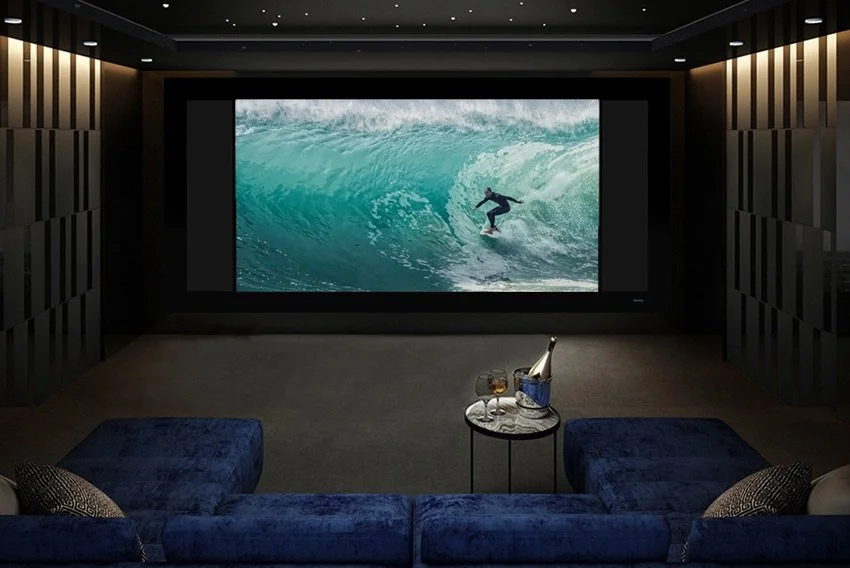
The Screen Is Half the Picture
Every photon your projector produces has to bounce off a surface before it reaches your eye. That surface sets the gain, the color neutrality, the black level in a lit room, the viewing angle, and whether your center channel can live where it belongs, behind the image. Spend six figures on projection and pair it with the wrong screen and you have thrown away the difference.
Stewart Filmscreen has been manufacturing projection screens in California since 1947, with over seventy years in the industry and Stewart states it is the only screen manufacturer to win an Academy Award for technical merit, with two to its name. Their own line is "The Reference for Stunning," and it is the surface that post production suites, screening rooms, and reference private cinemas are built around. Outside the standard size Cima line, every screen is made to order, to the room it is going into, in sizes and shapes no catalog product can match.
We sell the best of the best, so we lead with the best Stewart makes. As an authorized dealer, VIP Smart Homes designs, specifies, sells, installs, and calibrates the full Stewart lineup, and for a serious private cinema the recommendation starts at Director's Choice.
Director's Choice. Four Way Masking, Continuously Variable.
Films are not all one shape. A 2.40:1 CinemaScope feature, a 1.85:1 theatrical release, a 16:9 broadcast, a 4:3 archive print. Every one of them wants a different frame. On a fixed screen, three of those four leave gray bars sitting inside your picture area, and a gray bar is light. It raises the black floor of everything next to it and it tells your eye exactly where the screen ends.
Director's Choice solves it mechanically. Four motorized velvet masking panels, top, bottom, left, and right, close in on the image and stop wherever the content needs them to. Not four presets. Continuously variable, so any aspect ratio, including the ones that do not have a name, gets framed exactly. Each panel can be jogged independently, and positions are stored as presets your control system recalls with the source.
The result is the thing your eye does not consciously register and cannot unsee once it is gone: the picture has a hard black border on all four sides, at every ratio, all the time. Contrast goes up. The screen stops looking like a screen.
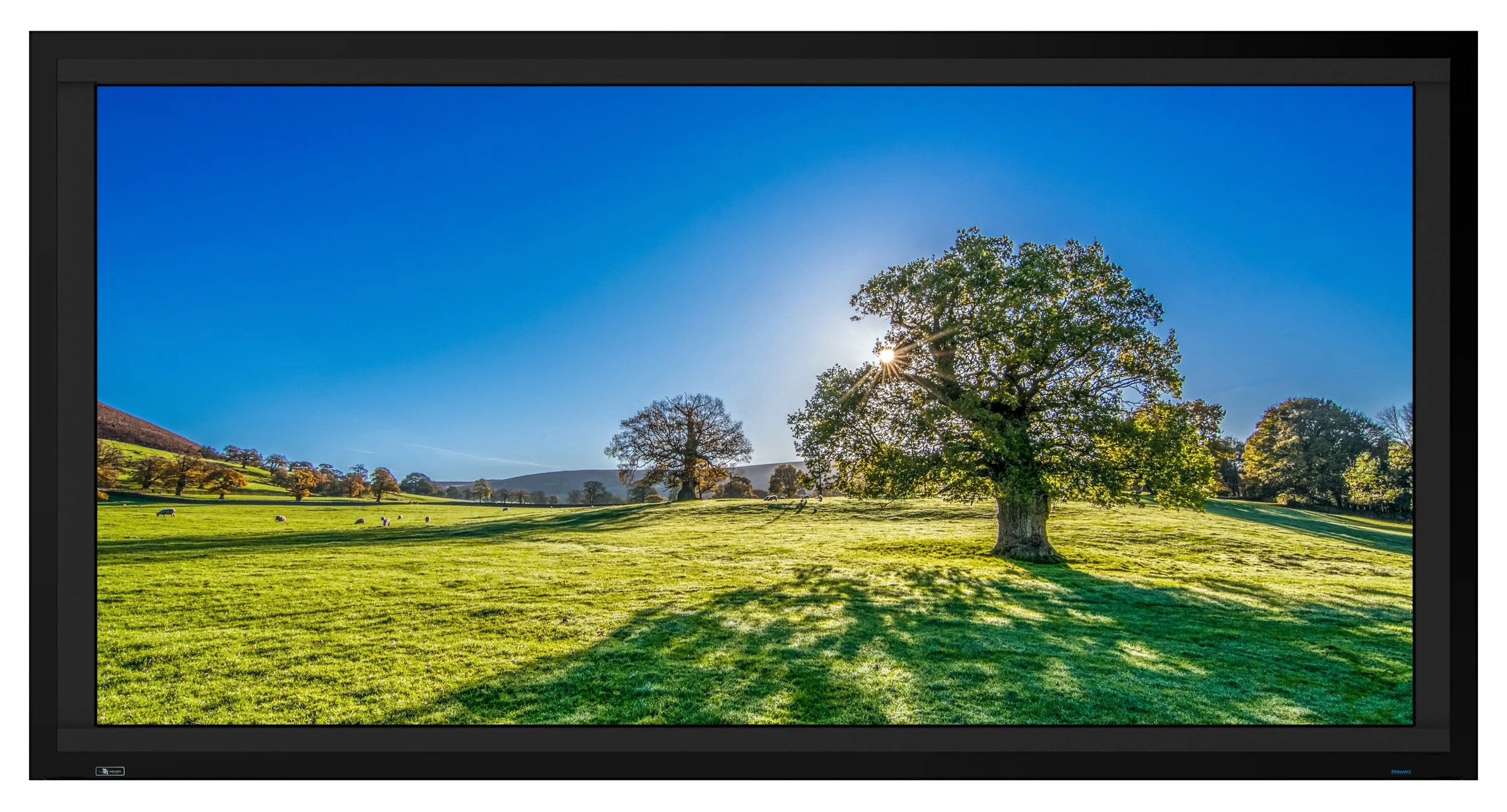
Director's Choice EVO, four way masking framing a widescreen image
Four Different Ways to Break a Screen
Content does not stress a projection surface evenly. Each of these puts a different kind of pressure on the material, and a reference screen has to hold up under all four without you ever thinking about it.
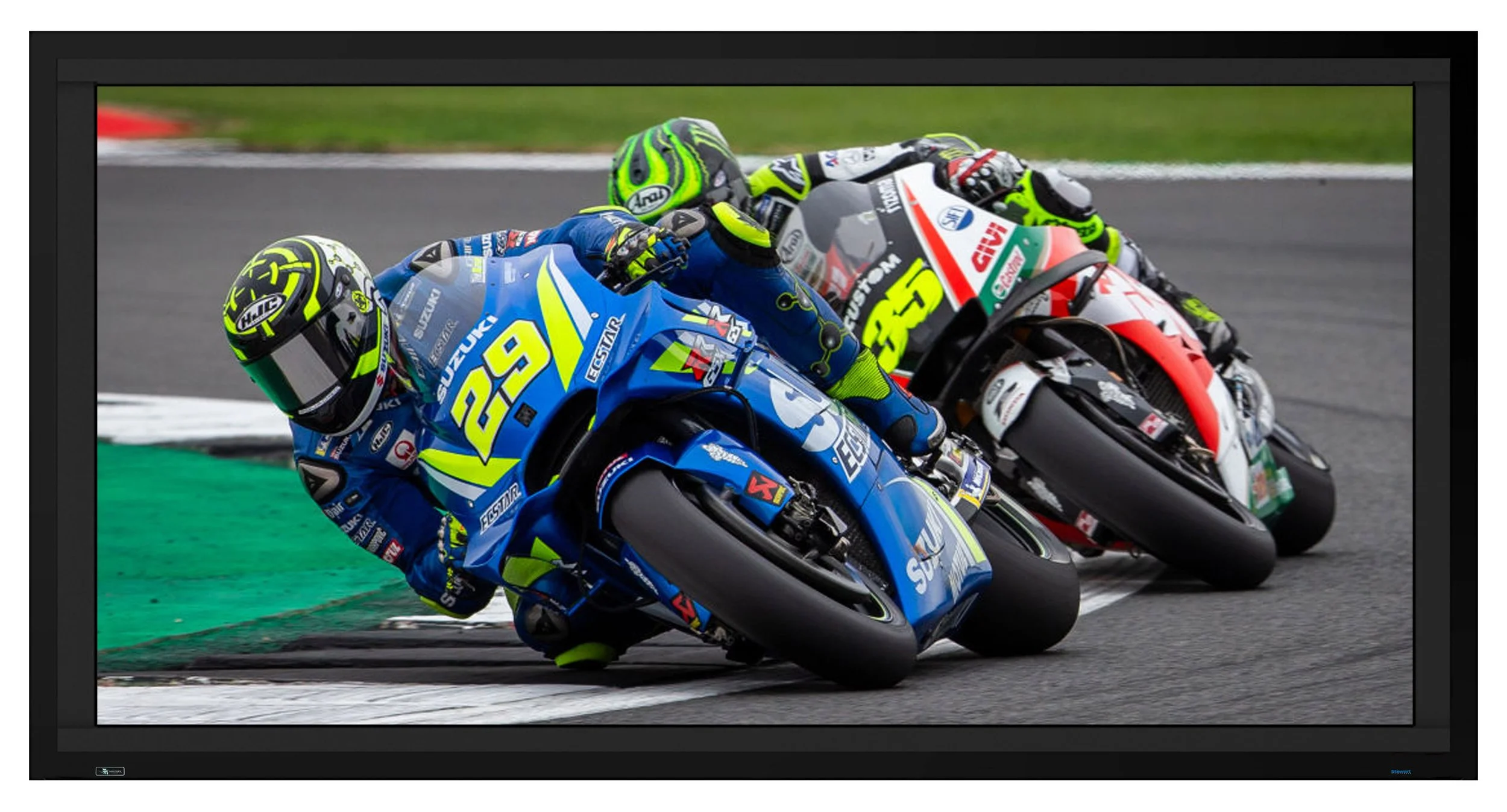
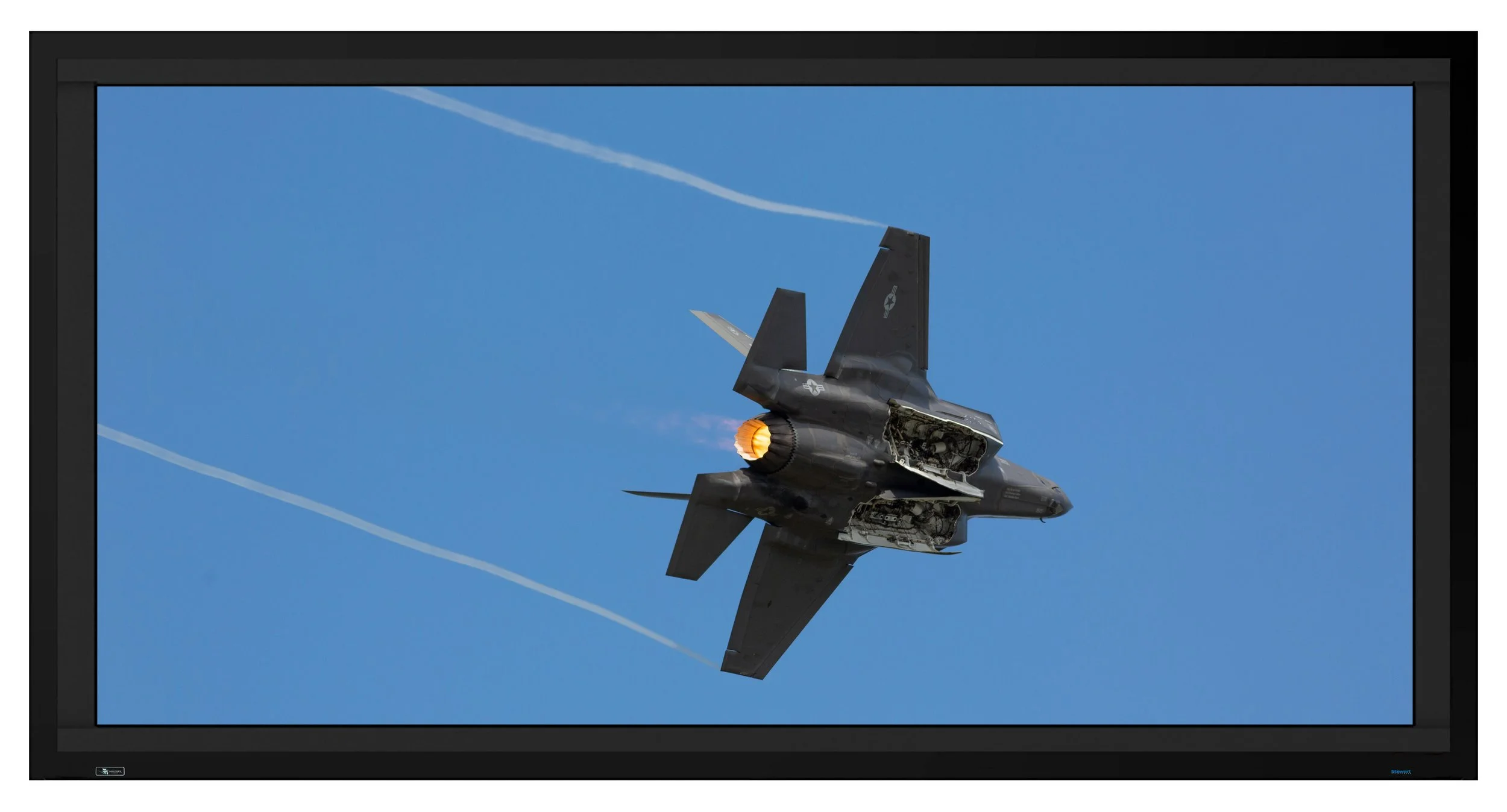
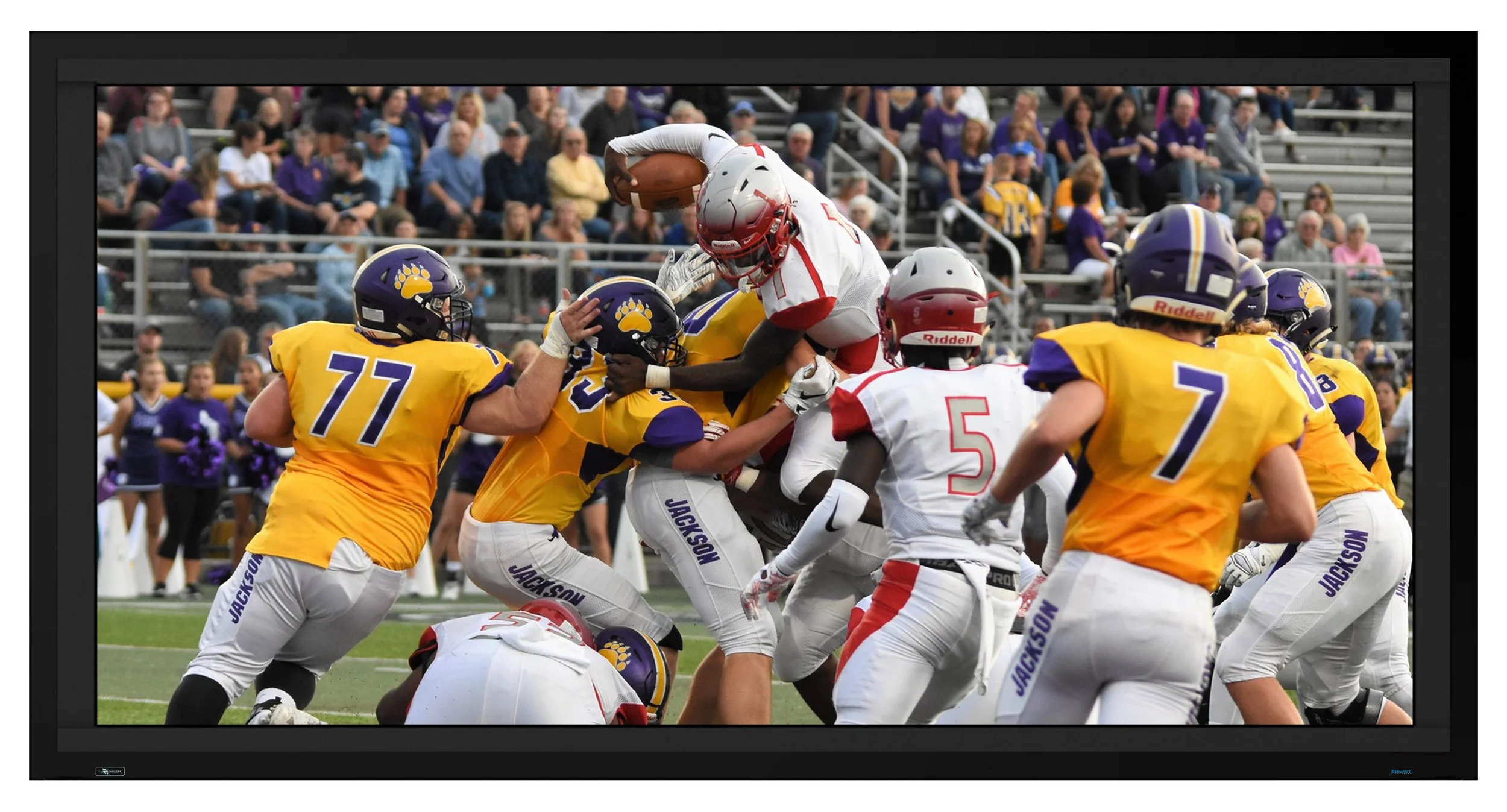
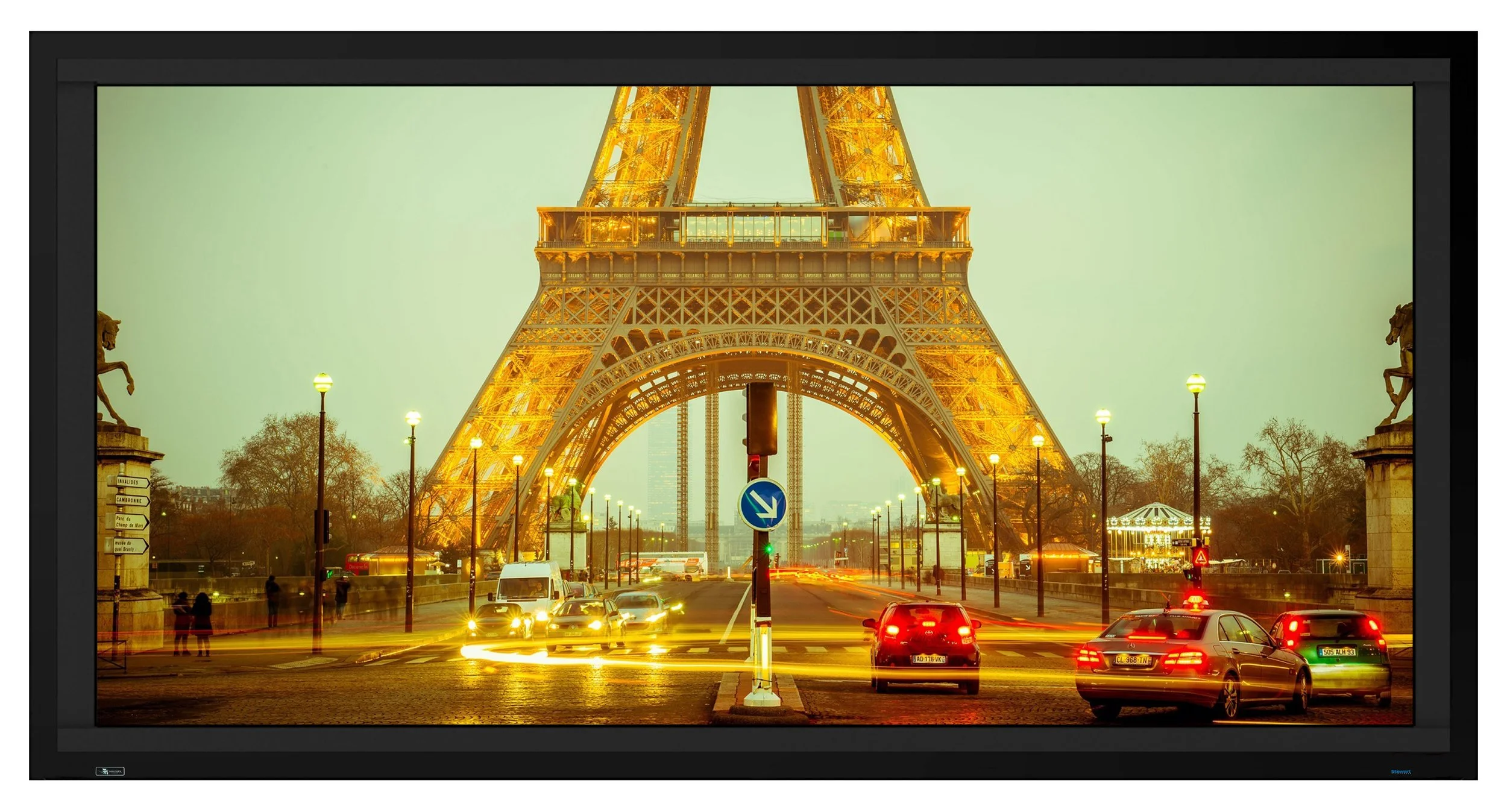
A flat expanse of sky is the cruelest test a screen faces, because any hot spotting, any coating variation, any seam shows up instantly across an area with no detail to hide behind. That is the specific problem StudioTek 130 G4 was built to solve, and it is why Stewart's own description leads with white field uniformity rather than brightness.
Director's Choice EVO product photography courtesy of Stewart Filmscreen.
Every Director's Choice is a custom build. Frame size, material, perforation, velvet finish, and control integration are all configured to your drawing. Masking presets are programmed to your sources and recalled from a Control4 or Crestron button so the room reframes itself when you press play. Nothing about this product ships from a size chart.
VistaScope and Manual Masking
Not every room needs four way masking, and we will say so. If your cinema is scope first and the width is fixed, VistaScope gives you two way constant height masking on the same continuously variable control platform, with presets from 2.40:1 through 1.33:1. The EVO chassis reaches 80 inches tall by 192 inches wide and the 300 chassis reaches 90 inches tall by 216 inches wide.
If motorized masking is not in this phase of the budget, Stewart Manual Masking Panels convert a WallScreen Deluxe or WallScreen 2.5 between CinemaScope and 16:9 by hand. It is not as elegant, and it is a real answer for a room that will be upgraded later.
Our recommendation is honest about where the money goes. If the choice is Director's Choice with a good projector, or a fixed screen with a great projector, we will walk you through both in your room before you commit.
The World's Largest Director's Choice
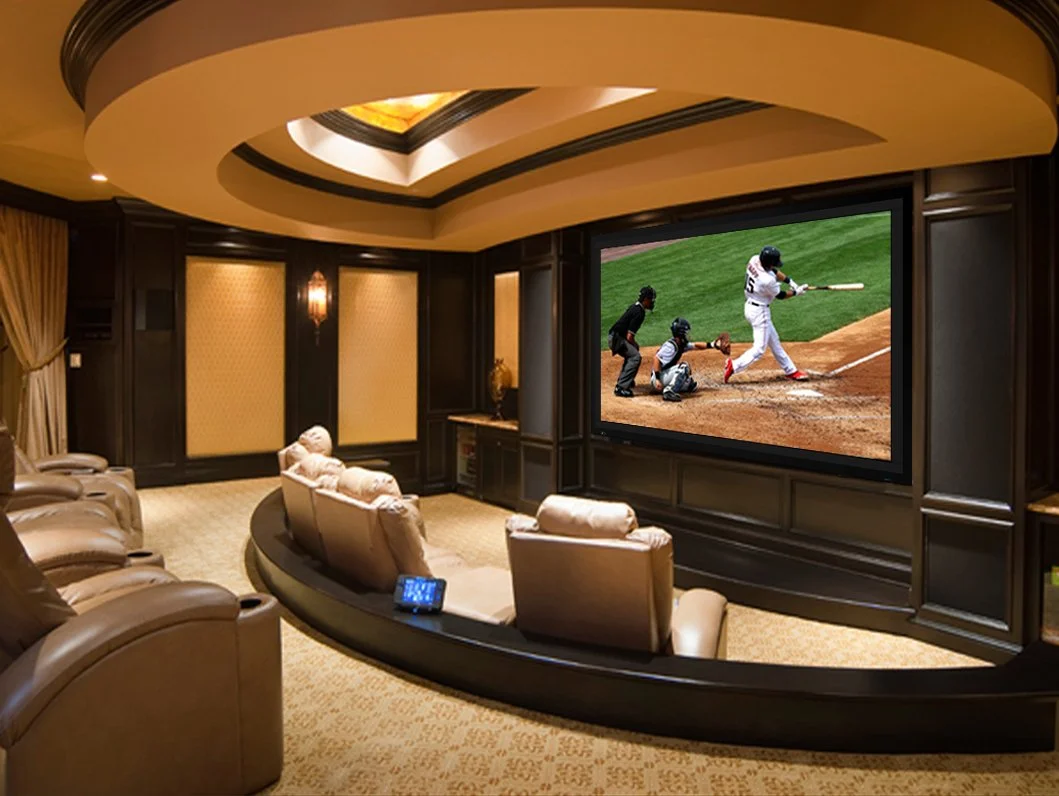
When the University of Nevada, Las Vegas rebuilt a nearly fifty year old lecture hall into a 250 seat Dolby Atmos film school theater, the screen at the center of it was a Stewart Filmscreen Director's Choice fixed frame system measuring 354.66 inches maximum diagonal in a 1.85:1 aspect ratio. Stewart calls it the largest Director's Choice ever built.
Continuous four way masking lets the students view content in any aspect ratio. The material is SnoMatte 100 with acoustically transparent perforation, chosen for its color and white field uniformity because SnoMatte 100 is a standard surface for digital intermediate and color editing work. The whole room went from demolition to completion in roughly 100 days.
That is not a residential project, and it is the clearest illustration of what this system is: the same masking platform that frames a film school's color grading suite is the one we put on the wall of a private cinema in Medina.
"With the updated and immersive environments, including ultrabright 4K laser projectors, a seamless 26'x14' Stewart Filmscreen, and Dolby certified sound, our students now have full access to visual composition, cinematography, editing, performance, production design and sound recording, mixing, editing, and design."Heather Addison, Ph.D., Chair and Professor, UNLVStewart Filmscreen case study, World's Largest Director's Choice. Integrator CCS Las Vegas, consultant Coherent Design.
 Authorized Dealer
VIP Smart Homes
Seventy Plus Years of Reference Standard Manufacturing
Stewart is not a screen brand that sources fabric and assembles frames. They formulate and coat their own optical materials, generation after generation, and build every screen to order in California.
Over seventy years in the projection screen industry, with all projection screens and screen materials produced in their California facility.
Stewart states it is the only screen manufacturer to win an Academy Award for technical merit, and it holds two.
THX Ultra and ISF certified, with membership in SMPTE and the A.N.S.I. steering committees that write the standards.
Stewart designates the current material catalog 4K, 8K and 16K Ultra HD ready, so the surface will outlast several generations of projector.
Stewart can produce a seamless surface up to forty feet tall by ninety feet wide. No seam line through your image, at any residential size.
Screen fabrics and mounting systems are GREENGUARD Gold certified for low chemical emissions, which matters in a sealed, acoustically treated theater.
Not Our Words. Theirs.
Published reviews and named professionals, quoted with attribution.
"Stewart Filmscreen's new ST130 G4 establishes a new reference standard for a gain screen."Kris DeeringSound & Vision, StudioTek 130 G4 review, 2020
"Because of Stewart's finesse with image uniformity and flatness, I insist on only Stewart screens for every telecast."David Taylor, projection supervisor for the Academy Awards telecastQuoted in Widescreen Review, 2006
"Stewart Filmscreen dominates the projection screen industry in both technical capability and image fidelity and that's what Sundance facilities require."Holden Payne, Technical Director, Exhibition and Production, Sundance InstituteQuoted in Sound & Video Contractor, 2015
"By reputation the Studiotek 130 is the closest thing to a perfect screen on the market."Evan PowellProjectorCentral, Stewart screens review, 2004
"Stewart Filmscreen's Harmony G3 unfailingly upholds reference-level performance, making it a compelling solution for installations where acoustic transparency and image accuracy will be held to the highest standard."Michael P. HamiltonProjectorCentral, Harmony G3 review, 2026
"In the end, I think the G4 is a very capable screen, worthy of the Stewart name and the FireHawk legacy."Cliff HeyneAudioholics, FireHawk G4 review, 2014
The Coating Is the Product
The frame holds the picture. The material makes it. Stewart formulates and coats its own optical surfaces in house, and the generation suffix (G3, G4, G5) tells you which revision you are getting. Gain is how much light the surface returns compared to a reference white. Half gain angle is how far off center you can sit before brightness falls to half. Minimum throw distance is the closest the projector can sit, expressed as a multiple of image width, and it is the spec that quietly kills more designs than any other. Higher gain buys punch and costs viewing angle. There is no universally best material, only the right one for your room, your projector's output, and where people actually sit.
| Material | Gain | Half Gain | ALR | Min Throw | Best For |
|---|---|---|---|---|---|
| StudioTek 130 G4 | 1.3 | 80° | Not ALR | 1.3x width | The industry reference. THX certified, thirty percent brighter than a matte white surface, with a wide seating angle. Our default recommendation for a light controlled dedicated theater. Can be perforated. |
| StudioTek 100 | 1.0 | Lambertian | Not ALR | 0.3x width | Unity gain with near perfect diffusion, so brightness is virtually unchanged from any angle. Reference accuracy for critical evaluation, and excellent edge blending properties. Can be perforated. |
| FireHawk G5 | 1.1 | 35° | Yes, 73% | 1.6x width | Superb black levels and shadow detail, designed as the best available tradeoff between image fidelity and ambient light resistance. The long standing favorite for high end media rooms. Can be perforated. |
| Phantom HALR Plus | 1.3 | 27° | Yes, 80% | 1.6x width | The most aggressive ambient light rejection in the front projection catalog. For rooms with real, persistent daylight and a controlled seating cone. Can be perforated. Note that Stewart also lists a separate Phantom HALR at 1.0 gain and 30 degrees. |
| Harmony G3 | 0.7 | Lambertian | Not ALR | 0.3x width | Woven acoustically transparent. Speakers live behind the picture with no perforation pattern to interact with the projector pixel grid. The current generation of Stewart's acoustically transparent weave, and it is not separately perforated. |
| GrayMatte 70 | 0.7 | Lambertian | Yes, 38% | 0.1x width | A neutral density gray that performs when a very bright projector is aimed at a small surface. The shortest minimum throw in the line, ultra short throw compatible, and it dampens cross reflection in deeply curved or circular installations. Can be perforated. |
| BlackHawk UST | 0.55 | 85° | Yes, 80% | 0.3x width | Built for ultra short throw. A lenticular structure redirects the extreme incident angles a UST projector throws. Stewart lists it as a Balón Series material, and it cannot be perforated. |
| SnoMatte 100 | 1.0 | Lambertian | Not ALR | 0.3x width | Unity gain matte white, chosen for color and white field uniformity. A standard surface for digital intermediate and color editing work, and the material specified for the world's largest Director's Choice at UNLV. |
| Neve (Cima) | 1.1 | 80° | Not ALR | 0.3x width | Cima exclusive. A very smooth surface with the widest viewing cone when ambient light can be controlled. Order Perforado for the perforated version. |
| Tiburon (Cima) | 0.8 | 80° | Yes, 40% | 0.3x width | Cima exclusive. A tightly held neutral gray with no color shift of any type, for rooms with moderate ambient light and a wide seating spread. Can be perforated. |
Gain, half gain, ambient light rejection and minimum throw distance figures as published by Stewart Filmscreen on their current material data sheets, checked August 2026. Lambertian means observed brightness is the same regardless of viewing angle. Materials marked Not ALR are not designated ambient light rejecting by Stewart; each still carries a small published ambient light rejection value on its own data sheet. Stewart's material sheet also notes that a screen can have an opaque backing layer or be perforated, but not both. UltraMatte, Classic White, Estero 100, Silver 3D and 5D, rear projection materials (AeroView, FilmScreen, LumiFlex) and rigid acrylic surfaces (AeroPlex, Graphite 70) are also available and specified case by case. Specifications change between material generations, so we confirm the current Stewart data sheet on every order before anything is built.
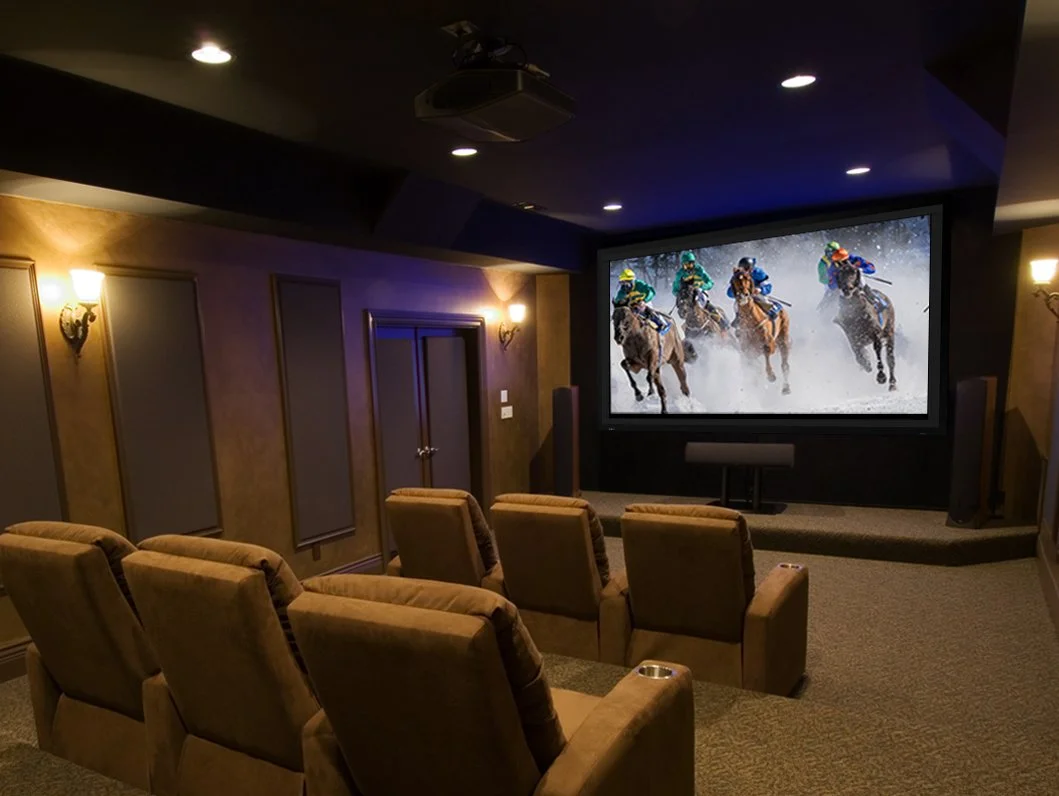
Voices Come From the Actor's Mouth
In a commercial cinema, the left, center, and right speakers sit behind the screen. That is not a compromise, it is the design. Dialogue anchors to the face on screen and effects pan across the image rather than across a speaker shelf below it. Once you have heard a properly built acoustically transparent front stage, a center channel sitting under the picture sounds exactly like what it is.
Stewart offers two routes. Harmony G3 is a woven material, so sound passes through the weave itself with no perforation pattern to interact with the projector's pixel grid. MicroPerf X2 THX Ultra is a micro perforation applied to the front projection materials, so you can keep StudioTek 130 G4 or another reference surface and still put speakers behind it. CinemaPerf covers the same requirement at large cinema sizes, and a perforated SnoMatte 100 is what UNLV specified on the world's largest Director's Choice.
One constraint worth knowing before you design the room, and it comes straight off Stewart's own material sheet: a screen can have an opaque backing layer or be perforated, not both. Which route is right depends on your projector resolution, throw distance, seating distance, and the speakers going behind it. We measure and specify rather than defaulting to one answer. Pair with Focal or Episode front stage speakers, or go fully hidden with Stealth Acoustics elsewhere in the room.
For Rooms With Windows and a View
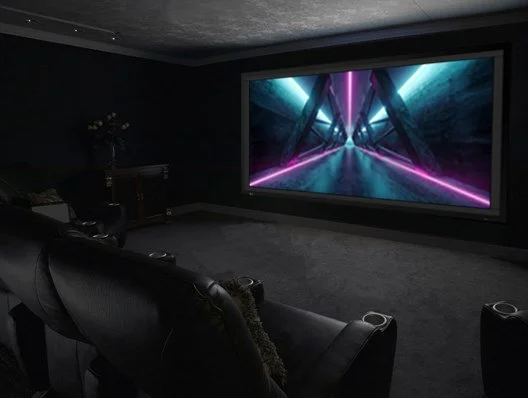
Pacific Northwest homes are built around glass and daylight. Waterfront rooms in Medina, Mercer Island, and Hunts Point are not going to be blacked out, and they should not have to be. An ambient light rejecting surface is engineered to accept light arriving from the projector's angle and reject light arriving from everywhere else, so the picture holds contrast while the room stays livable.
FireHawk G5 rejects 73 percent of ambient light with a 35 degree half gain angle. Phantom HALR Plus pushes to 80 percent with a tighter 27 degree cone. The tradeoff is real and it is geometric: the more aggressively a surface rejects off angle light, the narrower the seating positions that see full image brightness. Both need at least 1.6 times the image width in throw distance, which is a room planning constraint, not a preference.
That is a design decision, not a product decision, which is why we map your actual seating layout and measure the room before recommending a material. Combine an ALR surface with Lutron motorized shading and a movie scene that drops the shades automatically and you get a room that works in daylight and turns into a cinema on demand.
When the Screen Needs to Disappear
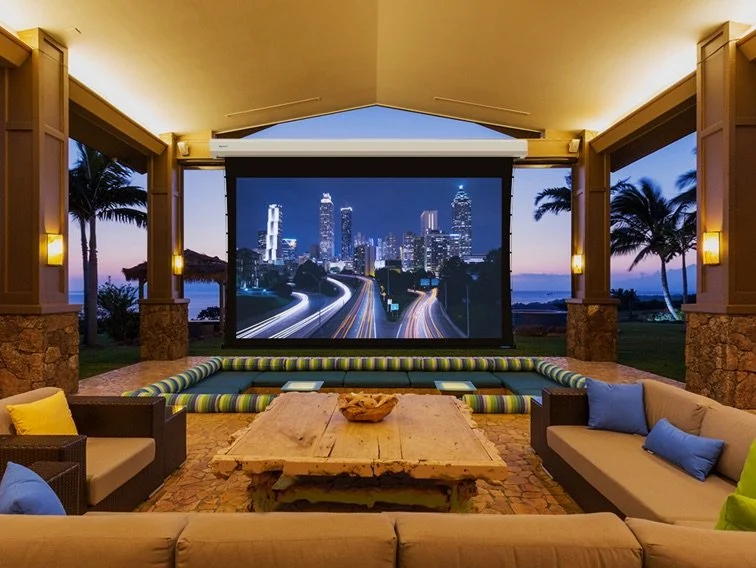
A dedicated cinema wants a fixed frame. A great room, a covered lanai, or a terrace with a view worth keeping wants the opposite: nothing on the wall at all until you ask for it. Stewart's motorized retractables drop from a ceiling case and roll away when the evening is over.
The difference between these and a consumer roll down screen is tension. Stewart uses stressed roller tubes, up to ten inches in diameter on the Grande series, so the surface hangs dead flat instead of rippling. A wave in the fabric is a wave in the picture, and it is the single most common reason a retractable looks worse than the projector paired with it.
Cascade G2 hides entirely above the ceiling in a plenum rated case. Stealth Grande uses a ceiling trapdoor, so the ceiling reads as solid until it opens. RS1 is the compact option, rated for indoor or outdoor use, which is what makes covered patios and pool decks possible. All of it ties into the same Control4 scene that dims the Lutron lighting and starts the movie.
Custom Sizes. Custom Shapes. No Seams.
Stewart can produce a seamless surface up to forty feet tall by ninety feet wide, curve an AT 3.0 frame to a specified radius down to twelve feet, and build to a drawing rather than a size chart. If your room has an odd wall, a structural constraint, or an aspect ratio nobody sells off the shelf, that is a manufacturing question, not a dead end.
The Last Surface Before Your Eyes
Everything upstream, the disc, the processor, the projector, the calibration, exists to put light on this one surface. It is the least glamorous line on the proposal and the one that decides what you see.
When Director's Choice Is Not the Right Answer
Director's Choice is the flagship and it is not the answer for every room. A great room with a view needs a screen that vanishes. A media room needs a fixed frame that disappears into the architecture. Stewart builds all of it.
WallScreen Deluxe
The most specified Stewart fixed frame. A 1.5 by 3.25 inch velvet wrapped profile that absorbs projector overshoot and visually deepens the image. Compatible with manual masking panels.
Up to 131 in H x 233 in WWallScreen 2.5, 1.5 and UST
Minimal border and narrow square tube variants for rooms where the wall is tight or the design brief calls for less mass around the picture, plus a version engineered for ultra short throw geometry. Each has its own size ceiling.
2.5 to 92 x 164 · 1.5 to 125 x 222 · UST to 131 x 233Balón Edge and Borderless
Wraparound frames with a half inch overscan border or no visible border at all, protruding no more than 1.5 inches from the wall, with an optional LED light rail. BlackHawk UST material is a Balón Series option.
Up to 16 ft diagonalCascade G2
Above ceiling electric retractable with an integral control system and a plenum rated case, so the whole screen lives in the ceiling cavity and only the fabric drops. Cascade won a 2020 CE Pro BEST Award in the projection screen category.
Up to 205 in diagonal, 16:9Luxus and Stealth Grande
Motorized retractables on stressed roller tubes for very large images, up to 540 inches wide, plus the ceiling mounted trapdoor system Stewart calls the largest concealed screen available anywhere.
Grande up to 540 in WRS1 and Cima
A compact 5.5 inch case retractable rated indoor and outdoor for media rooms and covered patios, plus the Cima value engineered line in standard sizes with faster turnaround.
RS1 up to 180 in diagonalWe will tell you which tier your room needs. Stewart is what we specify when the screen is the system: dedicated cinemas, DCI grade rooms, acoustically transparent front stages, motorized masking, and custom sizes. For media rooms where the budget is balanced across the whole system, Dragonfly remains our value tier and delivers strong performance at sensible pricing. Both are real answers. Which one applies to your room comes out of the consultation, not out of a catalog.
Measured First. Ordered Second.
We measure throw distance, seating positions and viewing angles, ceiling height, wall color and reflectivity, and how much ambient light the room actually holds at the hours you use it. That data picks the material, not a preference.
Every Stewart material has a minimum throw distance expressed as a multiple of image width, from 0.1 times image width on GrayMatte 70 to 1.6 times on the most aggressive ambient light materials. If the projector cannot sit that far back, the material is off the list no matter how good it looks on paper. We check this first.
Screen size and gain are calculated against your projector's measured output so the image lands in the right foot lambert range for the content, whether that is SDR film or HDR. Oversizing a screen is the most common and most expensive mistake in this category.
Frame, material, perforation, masking, velvet finish, and case are configured to your drawing and placed through authorized channels with full factory support and warranty. Custom sizes and shapes are ordinary work here, not an exception.
Structural mounting, concealed wiring, lens shift and geometry alignment to the frame, masking presets programmed to your sources, then full ISF and CalMAN calibration with the projector tuned to the specific screen material in the finished room.
The screen is one layer of the room. A Stewart surface belongs in a room designed around it: projection and theater design, acoustic treatment, seating and sight lines, Lutron cinema lighting scenes and blackout shading, Kaleidescape reference sources, and Control4 automation so one button runs the whole sequence, masking included.
Common Questions About Stewart Filmscreen
What is Director's Choice and why is it the flagship?
Director's Choice is Stewart's four way continuously variable masking system. Motorized velvet panels close in from the top, bottom, left, and right and stop anywhere, so any aspect ratio gets a hard black border on all four sides instead of gray bars inside the picture area. Gray bars are light, and light next to a dark scene raises the perceived black level of everything around it. Masking removes that. It is available in EVO, 100, 200, and 300 chassis, up to 168.5 inches tall by 300 inches wide, and it is the single most dramatic upgrade in a dedicated cinema once the projection is already sorted.
What is the difference between Director's Choice and VistaScope?
Director's Choice masks from all four sides, so it handles both constant height and constant width content and any ratio in between. VistaScope masks two ways for constant height, with presets from 2.40:1 through 1.33:1, up to 90 inches tall by 216 inches wide. If your room is scope first and the image width is fixed, VistaScope does the job for less. If you want the frame to fit everything from a 4:3 archive print to a 2.76:1 feature, that is Director's Choice.
Is Stewart Filmscreen worth the price?
It depends on what is in front of it. Paired with an entry level projector in a bright bonus room, no, and we will tell you that. In a light controlled room with a native 4K laser projector, the screen becomes the limiting factor in the system and Stewart is where the money is best spent. The surface will also outlive three or four projectors, so amortized across the life of the room the cost difference looks very different than it does on the first proposal.
How much does a Stewart Filmscreen screen cost?
Pricing spans a very wide range because these are made to order. A Cima fixed frame in a standard size is a different conversation than a Director's Choice EVO with four way motorized masking and MicroPerf X2 THX Ultra StudioTek 130 G4. Frame family, size, material, perforation, masking, and finish each move the number. We provide an itemized quote after we have measured the room, and we quote the screen alongside the projector so you can see the tradeoff between the two directly.
Which Stewart material should I choose?
For a dedicated, light controlled theater, StudioTek 130 G4 is the reference default: 1.3 gain, an 80 degree half gain angle, THX certified, and thirty percent brighter than a matte white surface. For a room that keeps some ambient light, FireHawk G5 rejects 73 percent and Phantom HALR Plus rejects 80 percent, both trading viewing angle for contrast. If speakers go behind the screen, Harmony G3 woven or MicroPerf X2 perforation. For ultra short throw on a Balón frame, BlackHawk UST. The room decides, and we measure before recommending.
What is minimum throw distance and why does it matter?
Every Stewart material publishes a minimum throw distance as a multiple of image width, and it varies enormously: GrayMatte 70 works at 0.1 times image width, StudioTek 100 at 0.3 times, StudioTek 130 G4 needs 1.3 times, and FireHawk G5 and Phantom HALR Plus need 1.6 times. On a 120 inch wide image that is the difference between a projector one foot from the screen and one sixteen feet back. If the room cannot give the projector that distance, the material is not an option regardless of how good its numbers look. It is the first thing we check and the most common reason a design has to change.
What is an acoustically transparent screen and do I need one?
It is a screen the sound passes through, so the left, center, and right speakers sit directly behind the image the way they do in a commercial cinema. Dialogue then comes from the actor on screen rather than from a speaker below the picture. You need one if you are building a dedicated theater and care about the front stage. In a media room with a soundbar or a compact center channel, it is usually not worth the cost or the light loss. One design constraint: a screen can have an opaque backing layer or be perforated, but not both.
Harmony G3 woven, MicroPerf X2, or CinemaPerf?
Harmony G3 is a woven material, so acoustic transparency is built into the weave and there is no perforation pattern to interact with the projector's pixel grid. MicroPerf X2 THX Ultra is a micro perforation applied to a standard front projection material, so you can keep a reference surface like StudioTek 130 G4 and still put speakers behind it. CinemaPerf handles the same requirement at large cinema sizes, the option Stewart offers alongside MicroPerf X2 for large format screens. Resolution, throw distance, and seating distance all factor in.
Can I get a Stewart screen in a custom size or shape?
Yes, and that is one of the main reasons to buy Stewart. Every screen is built to order. Stewart can produce a seamless surface up to forty feet tall by ninety feet wide and curve an AT 3.0 frame to a specified radius down to twelve feet. If your wall, ceiling, or aspect ratio does not match anything in a catalog, that is normal work.
What is screen gain and does higher mean better?
Gain measures how much light the surface reflects back compared to a standard white reference. A 1.3 gain screen returns about 30 percent more light toward the center seating position than a 1.0 unity gain screen. Higher is not better on its own, because gain is bought by narrowing the cone of light. Phantom HALR Plus is 1.3 gain with a 27 degree half gain angle, while StudioTek 130 G4 is also 1.3 gain with an 80 degree half gain angle. Same brightness on axis, completely different rooms. The right gain is a function of projector output, screen size, room reflectivity, and seating layout.
Fixed frame or retractable?
Fixed frame every time if the room is dedicated, and Director's Choice is a fixed frame system. It is permanently tensioned, dead flat, and there is nothing to fail. Retractable is for rooms that are not only theaters: great rooms, living rooms, and spaces with a view worth keeping. Stewart's retractables use stressed roller tubes and tensioning to stay flat, and the Cascade G2 and Stealth Grande hide entirely in the ceiling when the screen is up.
Do you carry other screen brands?
Yes. Dragonfly is our value tier for media rooms and theaters where the budget is balanced across the whole system, with fixed, motorized, recessed, acoustically transparent, and ambient light rejecting options. Stewart is what we specify when the screen is the system. We will tell you plainly which one your project calls for.
Do you install Stewart screens outside the Seattle area?
Our primary service area is Seattle, Bellevue, Medina, Mercer Island, Clyde Hill, Hunts Point, Yarrow Point, Kirkland, Redmond, Sammamish, Bainbridge Island, and the greater Puget Sound region. For clients with properties elsewhere, including second homes, global estates, and marine vessels, we design and install worldwide to the same standard.
Put Director's Choice in Your Room
Schedule a complimentary consultation. We will measure the space, check throw distance, model the light, and specify the Stewart frame and material that is actually right for how you watch.
Schedule Your Free Consultation